
Earlier this week, I went to a conference and had conversations with a lot of different business owners.
As I had these conversations, I was consistently blown away by this one thing: so many business owners still feel like they're running their business blind.
I've mentioned a stat before that over 50% of business owners feel uncomfortable with their financials. In these conversations, that number felt like it was much, much higher.
When I explained how we at Bison CFO could help business owners, a number of times I was asked for examples. In giving those examples, I could quickly see that even when using the simplest language, people struggled to grasp what I was talking about.
In most cases, it became clear pretty quickly that there was a ton of value in what we could provide. But when speaking to non-business owners who had even less sense of the financials of a business, you could tell that it would never actually click.
There were two key things that kept popping up:
- People do a bad job of assessing the risk in their business
- They don’t know what the right tools are to keep themselves afloat
I'd had something else planned for this week, but based on those conversations, I felt like this was a good time to republish what I posted last year where I talked about the number one rule of business.
For those of you who are new, didn't read it or don't remember it, enjoy.
For those of you who did read it, I encourage you to still read it again. We cannot internalize these lessons enough.
RULE #1 OF BUSINESS: DON’T DIE
Don’t die. This is the singular thing that matters when running a business. The rule all business owners should live by.
It’s obvious. Stupid, even.
I’ve spent years helping business owners navigate financial chaos, and time again I come back to this reality: if you run out of money your business dies.
Yet so many of us skirt the edge of this cliff.
We want to scale and have others see us as successful.
But sometimes we forget the prerequisite to all of that: staying alive.
It’s not just about avoiding bankruptcy. It’s about understanding what actually puts your business at risk and building systems to prevent it.
Today we’re going to talk about the three biggest business killers and how to avoid them.
THREE BIGGEST BUSINESS KILLERS
RUNNING OUT OF CASH
Sounds obvious, right? But most owners still run their business by the bank balance. Not a forecast. Not a plan. Just: “Do we have money today?”
That’s like driving across the desert with no gas gauge.
We’ve all seen it:
You’re profitable on paper… but can’t make payroll. A big customer is late… and suddenly you’re begging vendors for terms. A tax bill hits… and your growth plans vanish.
I probably sound like a broken record at this point, but Profit ≠ Cash.
Cash is your oxygen. When it runs out, everything else becomes irrelevant.
CHASING TOO MANY THINGS
Strategic whiplash will kill you faster than a bad quarter.
You see a great acquisition opportunity, so you jump. You hear a competitor is launching a new offering, so you pivot. You get bored, so you start a new product line.
I once worked with a company that had just started a new division of the business and came across a “can’t miss” business acquisition opportunity. I wish I’d been wiser, but the new opportunity was enticing. The whole thing together meant three divisions all working together for one purpose. GOLD. Or not?
Two years later, the acquisition desolved and the new division was languishing. The split attention, at minimum, set their progress back two years. Not to mention the distraction from the main cash cow business!
Every new initiative pulls cash, people, and focus.
And death comes slowly… from the thousand cuts of distraction.
IGNORING RISK UNTIL IT’S TOO LATE
Most businesses don’t die from one dramatic event.
They die from the obvious stuff they ignored for too long:
- The tax reserve that wasn’t funded.
- The debt balloon no one budgeted for.
- The key employee who walked out with everything in their head.
These are one small cut after another. One ignored sign, then another, then another. Now it’s an avalanche that can’t be stopped.
If you can name your biggest risks, you can plan for them.
If you can’t? You’re one invoice, one lawsuit, or one bad month from the edge.
Most risks are survivable. But only if you see them coming.
HOW TO BUILD A BUSINESS THAT DOESN’T DIE
This isn’t about playing small and scared. The best operators know: you have to earn the right to keep playing. Durability is what gives you options.
The longer you stay alive, the more chances you get to be right.
And the more you avoid getting killed, the more you can actually grow.
The best companies… the ones who avoid dying, are the most risk-aware. Notice I didn’t say scared or reactive. Being aware doesn’t mean you act or are timid. If anything, awareness can allow you to act more aggressively in the right ways.
And to do this, you can’t leave survival up to chance. You have to systematize it.
And how do you do that? Here are three ways:
BUILD A 13-WEEK CASH FORECAST
Every Monday, pull your cash in, cash out, and see what’s ahead.
This is the radar for your business. It gives you 90 days of visibility.
Not 5-year projections. Not hope.
Just: are we about to run out of cash?
If the answer is yes, you just bought time to fix it.
And in business, time is life.
I talked more in depth about the 13-week cash forecast here.
MAKE DECISIONS THROUGH A STRATEGIC FILTER
Most businesses don’t die from a lack of opportunity, but from a lack of clarity.
Every new project, product, or partnership feels exciting, but excitement doesn’t mean fit.
You need a Strategic Filter.
Your long-term plan isn’t just a dream. It’s a defense mechanism. When it’s written down and reviewed regularly, it becomes a filter for decision-making.
When an opportunity comes up, ask: “Does this align with where we’re going, how we said we’d get there, and what we can realistically support right now?”
If not? It’s a no, even if it feels like a yes.
The businesses that survive aren’t the ones chasing the most.
They’re the ones with the clearest criteria for saying no.
Define your no’s as clearly as your yes’s.
BUILD CASH RESERVES
Cash reserves are boring until you need them. But when you do need them, they’re the difference between a hard month and a death spiral.
You don’t build cash reserves because you’re scared. You build them because uncertainty is inevitable: recessions, tax surprises, slow sales, and late payments. It’s not a matter of if something unexpected happens… but when.
We previously talked about the 3-bucket approach to cash decisions:
- Operating Cash: the water you need every day to run the business
- Strategic Cash: the water you’ve saved to fuel planned growth (growth & CapEx)
- Reserve Cash: the emergency tank for the emergencies (downturns & ugly surprises)
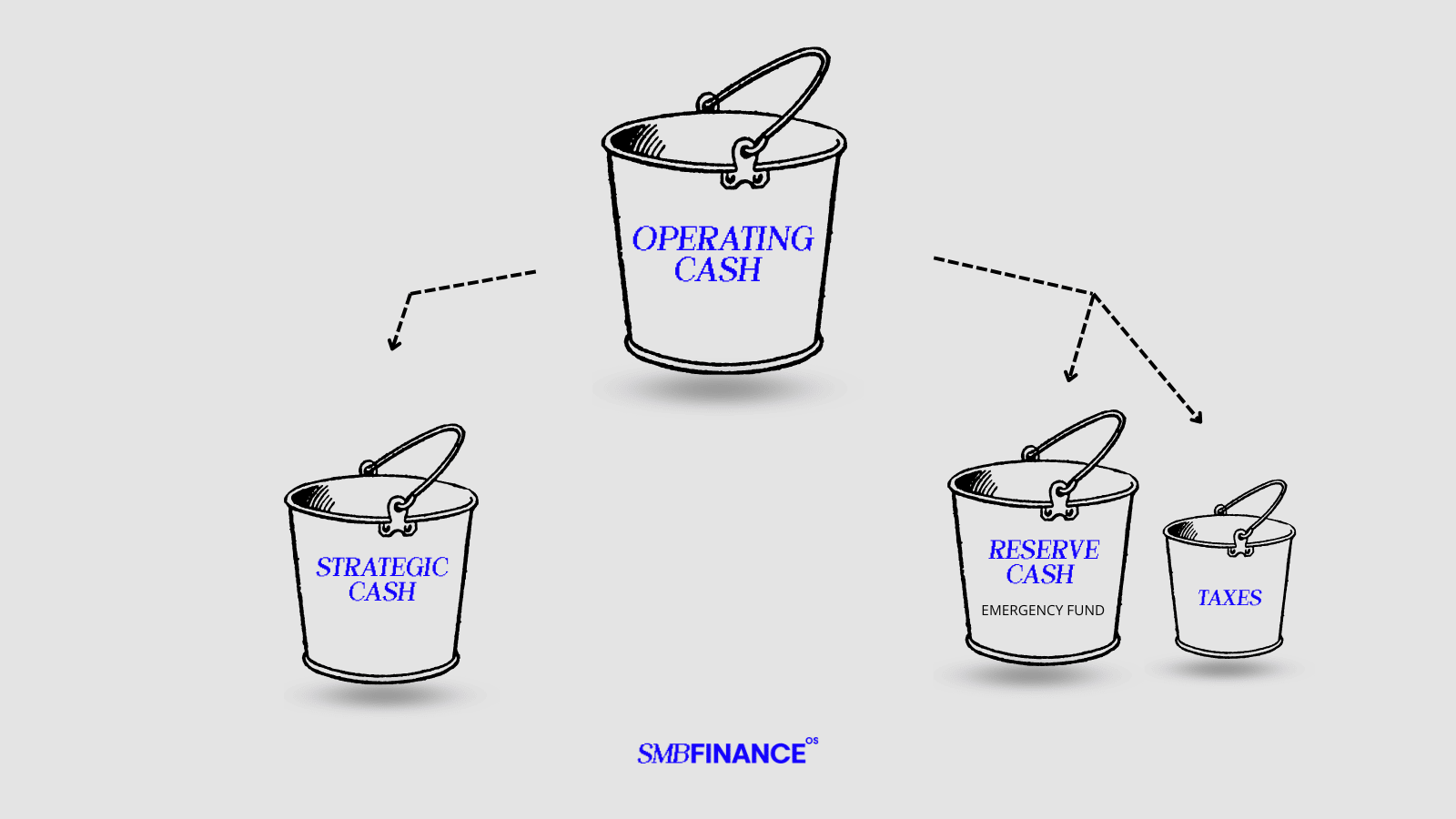
You don’t need to complicate it with a bunch of bank accounts (looking at you Profit First). But you do need to know how much you’re holding in each bucket and why.
Think of reserve cash like an insurance policy: The cost is peace. The benefit is survival.
THE BOTTOM LINE
You didn’t start a business just to play defense.
But playing defense is what keeps you in the game long enough to build something meaningful.
Rule #1: Don’t die. Rule #2: Everything else is secondary.
Take some time and ask the following questions:
- What would kill this business in 30 days?
- Where am I flying blind?
- What am I assuming will go right?
Your answers will show you where your systems are weak.
Then? You shore up the weak spots. You build the emergency fund. You set up the forecast. You set your team’s expectations.
Want help building systems that help your business breathe, grow, and survive the chaos? That’s what we do at Bison CFO, so reach out and let us help you.

